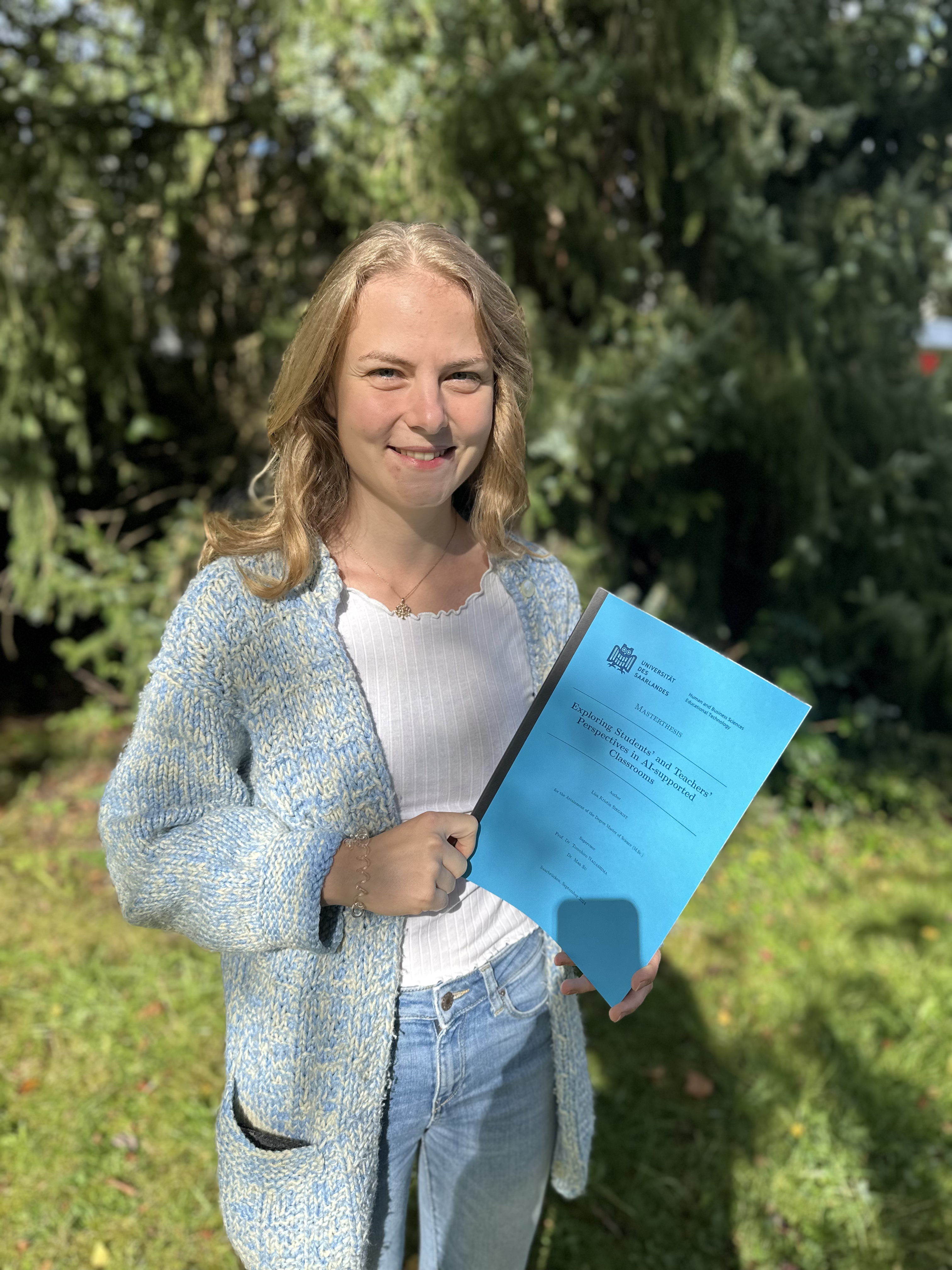
Exploring Student and Teacher Perspectives in AI-Supported Classrooms
Master’s Thesis for the Degree of Master of Science (M.Sc.)
Supervisors: Prof. Dr. Tomohiro Nagashima & Dr. Man Su
The increasing use of AI-supported technologies in classrooms is changing the roles of both students and teachers – particularly regarding student responsibility and autonomy. In a speed-dating-style interview study with 16 students and 15 teachers from secondary schools in Germany, perceptions and preferences regarding the use of AI in teaching were explored. Using storyboards depicting scenarios from full learner control to full AI control, both shared views and divergent ideas emerged. The results highlight the crucial role of the student-teacher relationship in the acceptance and design of AI systems in education. By incorporating both perspectives, the study aims to foster a more nuanced understanding of the interplay between human autonomy and AI automation.
This qualitative study was based on a speed-dating interview design. Sixteen students (previously interviewed in an earlier research project) and 15 teachers were asked about four dimensions of student agency in AI-supported learning (Nagashima et al., 2025): feedback and help, data, orchestration, and content. To stimulate discussion, interactive storyboards were developed to visualize potential AI-supported learning scenarios and illustrate real-life decision-making contexts. Here is an example of a teacher scenario. The storyboards served as a basis for reflective statements on control, autonomy, and co-creation.
For the analysis of the interview data, the affinity diagramming (AD) method was used – a visual, iterative approach to structuring qualitative data. Relevant quotes from the transcripts were independently coded by three researchers and transferred to digital sticky notes.
The quotes were then systematically grouped in several steps:
- Preparation: Organizing sticky notes by scenario (feedback/help, data, orchestration, and content)
- Horizontal: Thematic clustering within individual interview sections (e.g., feedback, data)
- Vertical: Cross-cutting patterns across different thematic areas
This process led to the identification of 13 intermediate themes and ultimately 5 overarching categories that were mapped to the four dimensions of student agency. This structured comparison allowed for shared and contrasting perspectives between students and teachers to be revealed – and informed design recommendations for AI-supported learning environments.
The analysis revealed sometimes significant differences in how students and teachers conceptualized control and autonomy in AI-based learning. While teachers often preferred hybrid control models – where AI supports but does not replace their decision-making – students emphasized their need for self-determination, especially in relation to feedback systems and the handling of personal data.
Regarding data use, a tension became apparent: students expressed strong desires for data protection and control over their learning and behavioral data, whereas teachers viewed access to such data as essential for targeted support. Both groups, however, emphasized the importance of trust in the AI system and a supportive learning environment in which technology is perceived not as a surveillance tool but as a learning aid.
These findings underline the need to develop transparent, adaptive, and participatory design approaches for educational AI systems that account for both student and teacher perspectives.
---
Nagashima, T., Vincoli, M., Scholz, N., & Su, M. (2025). Understanding students’ nuanced views on AI-supported classroom learning through perspective taking. In Proceedings of the International Conference on Artificial Intelligence in Education (AIED2025), Palermo, Italy